Showing posts with label work out. Show all posts

Wednesday, July 9, 2014

3 Digital Gym Etiquette Tips We All Need to Follow

When you're exercising at the gym, you know there are certain rules of thumb to follow—like, wipe down your machine when you're done. I mean, that's just common sense! But in this world of social media—doesn't almost everyone have her phone somewhere on her person while working out?—there are some digital rules you should keep in mind too, according to Randi Zuckerberg, founder-CEO of Zuckerberg Media and author of Dot Complicated.

gym-phone

* Limit your picture taking. You should be proud of all those milestones you hit at the gym—absolutely! But Zuckerberg says that you should also try to keep the pic-taking to a minimum—specifically focusing on major successes, such as lifting a specific weight. Taking pic after pic (or, ugh, selfie after selfie) is distracting to everyone else.
* If you're going to do a selfie, make it a selfie. It invades other people's privacy when you're posing prettily and they're sweating in the background of your Facebook pictures or Instagrams. Nope!
* Don't stop your workout to text or tweet. If you're on the machine but pause or slow down just to respond to a tweet or text a friend, it's super-annoying—especially for the people who may be tip-tapping their toes, waiting for you to finish, so they can move on with their own exercise sessions.
What are your phone-at-the-gym pet peeves?

Monday, June 30, 2014

The Most Popular Songs to Work Out To

Billboard have paired up with Spotify to poll their users (as well as those users' workout playlists) to generate the top songs people use for their workouts.
Here's a handy graphic to explain:
workout-playlist-billboard-540


And the actual playlist you can use for your own workouts!


What are your favorite songs to work out to?

Monday, February 18, 2013

Would You Rather: Do a Short, Intense Workout, or a Longer, More Leisurely Workout?

So what do you think: is it better to blast some calories in a one-hour intense bike ride, or over a longer, more meandering walk?

allyson-felix

Research has been back and forth on the topic--it wasn't too long ago that studies suggested a quick burst of high-intensity exercise may do a body extra-good--but now a new study is suggesting that long, slow walks may actually be better for you. Researchers say that standing instead of sitting whenever possible helps, too. 

According to a study published in PLOS ONE, volunteers who spent two hours standing and four hours walking each day had healthier insulin levels and lower triglycerides than when they spent an hour at the gym cycling. While the four hours of leisurely walking burned about the same number of calories as the one hour of cycling, the other health benefits were notable, say researchers. Triglycerides didn't show improvement with vigorous exercise, but were 22 percent better when volunteers spent less time sitting and more time walking.

There has been lots of research pointing to the fact that too much sit-time can have serious health consequences (like, uh, premature death. Eep), so this study may just be another piece of evidence that it's worth getting up from your chair and taking a stroll as often as possible.

Wednesday, February 6, 2013

4 Places at the Gym That Just Might Get You Sick

Want to hear something gross? (If you don't want to hear something gross, you should maybe skip to the third paragraph of this post. But it helps prove a point! So...you know, read at your own risk.)

fitness-germs

At my last gym, I noticed something that can only be described as truly yuck: previous shower-ers (or maybe just one who was extra-prolific?) were blowing their noses in the showers, sans tissue, and leaving the evidence for all to see. Without going into a rant about it (why? Why wouldn't you just use a Kleenex before hopping in the shower?), it was a reminder that, while gyms are good for us, and most facilities do their absolute best to keep things hygienic and tip-top, things can be germy.

In fact...want to know the places inside a gym that are most likely to get you sick? Sure you do!

Barbells, dumbbells, and weight plates. A basic sneeze can send 100,000 infectious particles into the air at 200 miles an hour--when someone catches those buggers with their hand instead of a tissue (or even an elbow), they can transfer easily to handheld gym equipment. Before you lift weights, spray down the equipment (gym etiquette says to do this after you're finished with your set, but how many people really follow that?).

Water fountains. A study from the University of Arizona found that 28 percent of gym surfaces are gym havens, and water fountains scored high on the list. One way to head off those bacteria? Bring your own water bottle!

Locker room floors. The moist floors are ripe for fungal and wart viruses (ew). Bring your flip-flops for showering, and never reuse the sweaty socks you've just worked out in.

Your own gym bag. This so makes sense: how often do you rush home and throw everything from your workout (including the bag) into the washing machine? I totally don't--my old socks sometimes live in my bag for weeks. Germs and bacteria gravitate toward sweaty workout clothes, so keep the dirty duds from touching the clean ones--a plastic bag can do the trick.

Sunday, January 20, 2013

How to Work Out the Most Important Part of Your Body

If you made New Year's goals to exercise more (lots of us! Me too!) and get healthier in general, then be sure to include a super-important body part in your workout regimen: your brain.
And I don't mean like this:

brain-workout

Ha. But seriously--how often do you exercise your brain? The experts behind Lumosity--a brain-training site--say it's important to give your brain regular workouts. Not just because it helps keep your brain healthy and happy, but also because it will help the rest of you get in shape! Take a look at their tips for keeping your brain shipshape (I love these):

Eat right. You do it for your body--why not your brain? Fruits and vegetables with antioxidants help prevent cell damage, and omega-3 fatty acids are important building blocks in the brain.

Go to the gym.
Regular exercise can help keep your brain fit with increased levels of brain chemicals and more efficient blood circulation. Studies have even shown that physical exercise stimulates the production of new brain cells.

Get out more.
Like, away from Facebook. We're social creatures and our brains really, really like social contact. Research has shown that having an active social life appears to delay age-related memory loss.

Sleep.
Sleep plays an important role in memory formation. Your brain uses sleep to process and make sense of the day, consolidate memories, and generate creative new ideas.

Get your brain in boot camp.
The best exercises for your brain are new challenges, such as memory games that use different parts of your brain and increase in difficulty as you improve on tasks. These games can even help improve self-esteem and willpower that can keep you motivated to carry out that resolution to exercise more.

(PS: The games on Lumosity are actually really fun--the site works with institutions such as Harvard, Columbia and UC Berkeley to get research in order to design games specifically to improve brain function. But let me say again: fun!)

Wednesday, October 10, 2012

Calorie-Torching Exercises To Do... While Sitting

We're all guilty of sitting for a few more hours a day than we really ought to--but between work and school, there's a lot of time that's devoted to spending time on our tushes. Luckily, if you're stuck in a seat for most of the day, you can still exercise... with Sitacise.
1001-sitacise_vg.jpg
According to Sitacise founders Kathy and Mark Brown, sitting sit for six or more accumulative hours your risk for heart disease increased by 54 percent. But if you do "NEAT"--non-exercise activity thermogenesis movements--you can help reduce your risk (and, bonus: burn lots of calories). Here are four exercises--er, Sitacises--that you can try from your chair, right this second. No, it's not quite the same as a regular workout--but at least you can do something when you're sitting.

Seated Water Bottle Curl
This tones the biceps, forearms, and wrists.
* Fill two water bottles.
* Plant your feet firmly on the floor. Hold the bottles to your sides near the top of your thighs.
* Slowly raise the bottles until they're shoulder high.
* Return to the starting position and repeat for up to 30 seconds.

Seated Leg Extension
Firms, shapes, and strengthens the front of the thighs and knees.
* Plant your feet firmly on the floor. The small of your back should be pressed firmly against the seat back.
* Extend one leg at a time, but don't lock out your knees.
* Return to starting position and repeat with your other leg; alternate legs as long as you can (or up to 30 seconds).

Water Bottle Bench Press
Tones the chest, shoulders, and upper back.
* Start with feet firmly on the floor.
* Hold bottles chest high and push straight out, but do not lock out your elbows.
* Slowly return to the starting position and repeat as often as desired (up to 30 seconds).

Seated Calf Raises
*Works the lower legs and helps recirculate blood back through the veins (this is good for helping prevent swollen ankles and feet, or deep vein thrombosis).
* Plant your feet firmly on the floor.
* Raise your heel while keeping your toes on the floor.
* Slowly return to the starting position and repeat until finished (or 30 seconds are up).

Wednesday, September 26, 2012

Today's Workout Motivation


Not feeling it today? If you need a little motivation to get to the gym or go on that lunchtime jog, here you go...


This Under Armour commercial has to be one of the best ever made:) There's something inspiring about seeing all these strong women working hard and feeling great.

Tuesday, September 18, 2012

Animals With Excellent Exercise Habits

These pics are helping me find a little exercise inspiration... or maybe I should say "aww"-spiration? 
Just take a look at these animals who are exercising (well, animals who at least look like they're exercising) and see what I mean.

Don't overeat before a workout:
0917-animal-exercise_vg.jpg

It's always important to stretch:

Source: flickr.com via Lexi on Pinterest
There's nothing like a good yoga pose to greet the day:

Might as well just not worry about your hair:

Skateboarding totally counts:

Balance exercises will help strengthen your core:

Always remember to stay hydrated:

And it's obviously important to give yourself some recovery time:

Source: flickr.com via Lexi on Pinterest

Tuesday, July 17, 2012

Working Out As a Couple: Awesome or Awkward?


Miley Cyrus is often (very, very often) photographed leaving her Pilates studio after a workout, but recently, she had an exercise partner that got paparazzi-ed too...


0716-miley-skateboard_vg.jpg


...fiancé Liam Hemsworth. And while we can't be sure that Liam was actually doing Pilates with Miley (maybe he was just cheering her on? Or admiring his hat in the mirror?), they were also spotted skateboarding together late last week, so it's somewhat safe to assume they exercise together once in a while, right?


I don't really know any couples that work out together--do you? I see couples who are working out side-by-side at the gym and they seem pretty content doing so, but I like exercising solo. I just need that space--to listen to music, to let my mind go wherever it needs to go, to push myself at my own pace in my own way. What about you?

Thursday, June 14, 2012

Yee Haw! Would You Work Out on a ... Mechanical Bull?

Recently I heard about a new fitness trend that looked ... sort of fun! 
 Would you try a mechanical bull workout class? Attention: Fitness First ;)

0612-mechanical-bull-workout_vg.jpg

At Travaasa, a destination resort and spa in Austin, Texas, you can take the Bull Riding Workout class, which is said to burn about 200 calories per hour and increase core strength and flexibility. But, all of that aside--it just looks like fun, doesn't it?

Thursday, April 26, 2012

The Best New Exercises You’re Not Doing

There's a popular saying among fitness experts: "The best exercise is the one you're not doing." The take-home message? To achieve the best results, you need to regularly challenge your body in new ways. So while classic movements like the pushup, lunge, and squat are the staples of any good workout plan, varying the way you perform these exercises every 4 weeks can help you avoid plateaus, beat boredom, and speed fat loss. 

You can start today, with this list of the best new exercises for every part of a woman's body. 


.
 

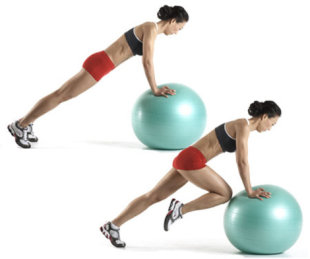
ABS: Mountain Climber with Hands on Swiss Ball

The benefit:
It's one of the simplest yet most effective ways to tighten your tummy. In fact, you'll barely have to move a muscle.

How to do it:
Assume a pushup position with your arms completely straight, but place your hands on a Swiss ball instead of the floor. Your body should form a straight line from your head to your ankles. Tighten your core and hold it that way for the duration of the exercise [A]. Lift one foot off the floor and slowly raise your knee as close to your chest as you can without changing your lower-back posture. Then repeat with your other leg. Alternate back and forth for 30 seconds. If that's too hard, place your hands on the floor or a bench, instead of a Swiss ball.

 
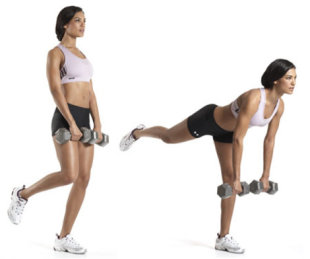
HAMSTRINGS: Single-Leg Dumbbell Straight-Leg Deadlift

The benefit:
Besides targeting your hamstrings, this exercise works your glutes and core. It also helps eliminate muscle imbalances between your legs, reducing your risk of injury. And as a bonus, it can even improve the flexibility of your hamstrings.

How to do it:
Grab a pair of dumbbells with an overhand grip, and hold them at arm's length in front your thighs. Stand with your feet shoulder-width apart and knees slightly bent. Now raise one leg off the floor [A]. Without changing the bend in your knee, bend at your hips (keep your lower back arched), and lower your torso until it's almost parallel to the floor [B]. Pause, then squeeze your glutes, thrust your hips forward, and raise your torso back to the start. Do all your reps, then repeat with your other leg.


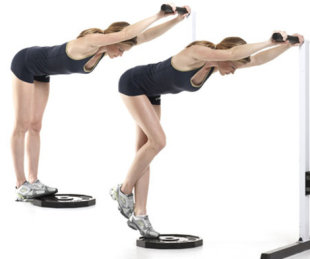
CALVES: Single-Leg Donkey Calf Raise

The benefit:
This simple exercise helps shape your calves in the comfort of your living room.

How to do it:
Place the ball of one foot on a step, block, or 25-pound weight plate. Cross your other foot behind your ankle. Grasp a sturdy object for support. Then keeping your back naturally arched, bend at your hips and lower your torso until your upper body is almost parallel to the floor [A]. Lift your heel as high as you can [B]. Pause, lower your heel, and repeat. Complete as many reps as you can--or for a duration of 60 seconds--then switch legs.


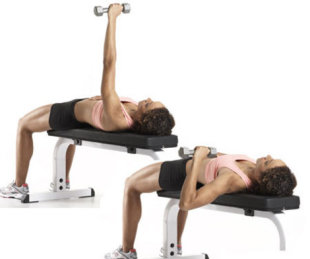
CHEST :Single-Arm Dumbbell Bench Press

The benefit:
This exercise works your glutes and abs as hard as it works your chest and triceps. So you'll tighten your hips and core as you tone your upper body.

How to do it:
Grab a dumbbell in your left hand and lie on your back on a flat bench, holding the dumbbell over your chest with your arm straight. Your palm should be facing out, but turned slightly inward. Place your right hand on your abs [B]. Lower the dumbbell to the side of your chest. Pause, then press the weight back to the start. Want an even greater challenge? Slide over so that only your right butt cheek and right shoulder blade are on the bench. (Don't let your hips sag; you'll have to place your left foot wider to maintain your balance.) Do all your repetitions, then repeat on your right side.  
 
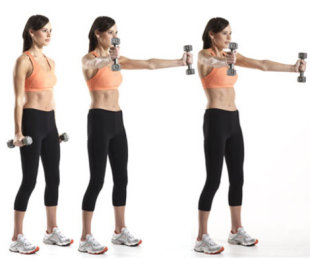
SHOULDERS :Scaption and Shrug

The benefit:
When you raise the dumbbells to start this exercise, you target the front of your shoulders as well as your rotator cuff. Then comes the shrug. This part of the move helps better balance the muscles that rotate your shoulder blades. The end result: Great-looking shoulders and better posture.

How to do it:
Stand holding a pair of dumbbells with your feet shoulder-width apart. Let the dumbbells hang at arm's length next to your sides, your palms facing each other [A]. Without changing the bend in your elbows, raise your arms until they're parallel to the floor, keeping them at a 30-degree angle to your body (so that they form a "Y") [B]. At the top of the movement, shrug your shoulders upward [C]. Pause, then reverse the movement to return to the start, and repeat.

 
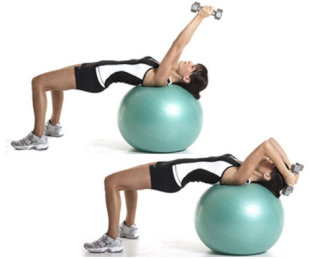
TRICEPS :Swiss-Ball Lying Triceps Extension

The benefit:
Lying on a Swiss ball forces your core to work harder to keep you stable. So you work your abs as you shape the backs of your arms.

How to do it:
Grab a pair of dumbbells and lie on your back on a Swiss ball so that your middle and upper back are firmly on the ball. Raise your hips so that your body forms a straight line from your knees to your shoulders. Hold the dumbbells over your forehead, with your arms straight and your palms facing each other [A]. Without moving your upper arms, bend your elbows to lower the dumbbells until your forearms are beyond parallel to the floor [B]. Pause, then lift the weights back to the start by straightening your arms.
 
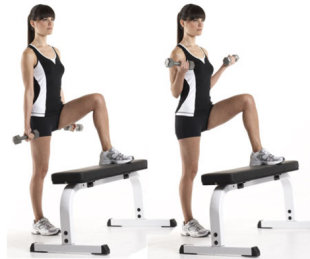
BICEPS :Split Stance Dumbbell Curl

The benefit:
Placing one foot in front of you on a bench forces your hip and core muscles to work harder in order to keep your body stable. That way, you engage more muscles and burn more calories than you would if you did the exercise in a regular standing position.

How to do it:
Grab a pair of dumbbells and place one foot in front of you on a bench or step that's just higher than knee level. Let the dumbbells hang at arm's length next to your sides, your palms facing forward [B]. Without moving your upper arms, bend your elbows and curl the dumbbells as close to your shoulders as you can [B]. Pause, then slowly lower the weights back to the starting position. Each set, switch the foot that you place on the bench.

 
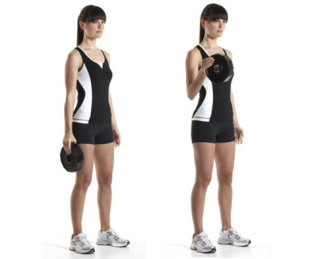
FOREARMS :Plate Pinch Curl

The benefit:
Strengthens the muscles of your forearms, hands, fingers, and thumbs, while also shaping your biceps. Bonus: Makes you better at opening jars, too.

How to do it:
Grab a pair of light weight plates in your right hand. Hold the two plates together with your fingers and thumb by pinching the smooth side of the plates. Let the plates hang at arm's length next to your side [A]. Without moving your upper arm, bend your elbow and curl the weights as close to your shoulder as you can [B]. Slowly lower the weights back to the starting position and repeat.


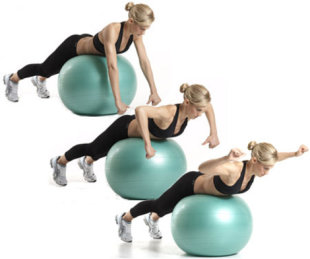
UPPER BACK :Swiss-Ball L Raise

The benefit:
This exercise targets your upper back. By working these key muscles, you'll improve your posture, shape the back of your shoulders, and look great in a backless dress.

How to do it:
Lie facedown on top of a Swiss ball so that your back is flat and your chest is off the ball. Let your arms hang straight down from your shoulders, your palms facing behind you [A]. Keeping your elbows flared out, lift your upper arms as high as you can by bending your elbows and squeezing your shoulder blades together. Your upper arms should be perpendicular to your torso [B]. Without changing your elbow position, rotate your forearms up and back as far as you can [C]. Pause, then reverse the movement. If you can do more than 12 repetitions, use dumbbells.


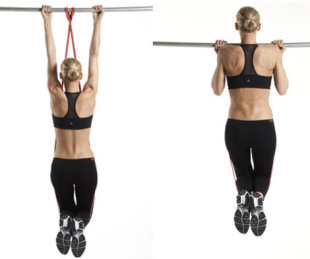
LATS : Band-Assisted Chinup

The benefit:
This exercise allows you to do full chinups, even if you've never managed a single one. Plus, it more accurately mimics the movement than lat pulldowns or the assisted chinup machine. All you need is a chinup bar and a large rubber band called a SuperBand.

How to do it:
Loop one end of a SuperBand around a chinup bar and then pull it through the through the other end of the band, cinching it tightly to the bar. (The thicker the band you buy, the more assistance it will provide.) Grab the bar with a shoulder-width, underhand grip, and place your knees in the loop of the band. Hang at arm's length [A]. Perform a chinup by pulling the top of your chest to the bar [B]. Pause, then slowly lower your body back to the starting position.


. 
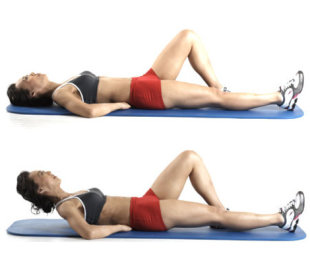
LOWER BACK : McGill Curlup

The benefit:
This exercise works your entire abdominal muscle complex while keeping your lower back in its naturally arched position. So it minimizes stress on your spine while increasing the endurance of the muscles, which helps prevent lower-back pain.

How to do it:
Lie on your back on the floor with your right leg straight and flat on the floor. Your left knee should be bent and your left foot flat. Place your hands palms down on the floor underneath the natural arch in your lower back [A]. Slowly raise your head and shoulders off the floor without bending your lower back or spine, and hold this position for 7 to 8 seconds, breathing deeply the entire time [B]. That's 1 rep. Do 4 to 5 reps, then switch legs and repeat. To make it even harder, raise your elbows off the floor as you curl up.

Tuesday, April 24, 2012

Do This Super-Simple Move to Burn an Extra 200 Calories a Day

You do this move already, I'll bet--during yoga, in the shower, on the phone--but you probably don't realize you're doing it. Your challenge now? To do it more often. The move I'm talking about, of course, is...


0423-one-leg-stand_vg.jpg

...holding a flower pot in the air. 

No, not really. Silly! The real move: stand on one leg. When it comes to calories, standing burns more than sitting--about 30 to 50 more per hour. Standing on one leg ("unipedal standing," if you're fancy) ups the ante, burning another 20 to 30 more calories on top of that--while also engaging your core muscles and improving your balance.

Just lifting one foot a few inches off the ground causes the rest of your body to work to center itself. If you want to work your body a little harder, try this: raise your foot and pull up your knee, Karate Kid-style, so it looks like you're about to climb a huge step. Do it while doing things like brushing your teeth, putting on makeup, washing the dishes, pouring a bowl of cereal, and switch legs with every new task. 

If you want to challenge yourself even more, slowly straighten your leg in front of you, then swivel it to the back. Standing on one leg in 10 to 12 five-minute increments can add up to an extra 200 calories per day--not bad at all!

3 Cool Ways to Bring At-the-Gym Workouts to YOU

I love learning about the newest ways of working out--whether the methods are crazy-good or just plain crazy. Do you? But there are days I'd just as rather stay home from the gym.
0423-workouts-home_vg.jpg

There are obviously tons of creative ways you can work out at home--DVDs, running around your house, standing on one leg. Here are a few others to add to the list:

1: Trampolining
I've wanted to try a trampolining class for just about ever. The problem? No classes near me, boo. Besides the insane fun that comes with boinging around for an hour, it's also an amazing workout choice: a study in the Journal of Applied Psychology has shown that just 10 minutes of trampoline jumping is equal to the health benefits of running for than 30 minutes. Also, trampolining is also supposed to be low-impact and gentler on your knees. Experts say that you can get a great workout at home on your own, performing simple muscle-strengthening moves like jumping jacks or tucks, where you pull your legs into your chest during the jump.


2: ElliptiGO
Is it an elliptical trainer? Is it a bike? It's both, kind of! If the at-gym ellipticals have one big fault, it's that they don't actually go anywhere. This little machine does--while seriously engaging your core muscles (which you have to do to keep from falling over), burning calories, and going easy on your joints at the same time. 


3: Juggling
It's not exactly a standard-issue class at every gym, but JuggleFit is a real workout that's all about--you guessed it--juggling. Why? Well, check out these health benefits: it helps improve coordination, strengthens your core, aids in warding off stress, and a study in Nature magazine even found that learning how to juggle could help build brain matter. Oh, and it also burns 280 calories an hour. Neat.


What's your favorite at-home workout? Is there a class at your gym that you'd like to replicate--in some fashion--at home?

Thursday, February 23, 2012

7 Fitness Myths, Busted

If you haven’t moved many muscles since high school gym class, you might not be up to speed on fitness myths, a stubborn bunch that just won’t die. A dose of reality right about now might strengthen your resolve.

Here’s a rundown on the seven top evergreen exercise myths that you’ll probably hear but can safely ignore:

No Pain, No Gain

Maybe this one took on a life of its own because it rhymes and is so easy to remember. Forget it. If an exercise causes pain, you’re either doing it wrong (a session or two with a personal trainer can set you straight) or you’ve already managed to hurt yourself.
Be sure to separate pain from muscle soreness, which comes on after you tax a lax muscle and will wear off in a few days. Actual pain can mean that you’ve exhausted a muscle or torn a ligament. If what you’re doing really hurts, stop.

Stretching Before Exercise

The idea here is that stretching before and after you exercise can prevent injury while you’re working out and muscle soreness afterward.
While stretching does promote flexibility (something you should strive for as an element of overall fitness), a study published in British Medical Journal found no scientific evidence to back up the notion that stretching before a workout reduces injuries or that stretching before and after can prevent muscle soreness.

Exercise Speeds Metabolism for Hours

While partly true--your metabolism does amp up during exercise and for a few hours afterward--the truth can be a big disappointment: the number of calories you can expect lose thanks to the afterburn is negligible, only 20 extra ones for the whole day according to one study.
But (and this is a really big “but”) you may be able to set your metabolism on high for hours after your workout if you can exercise intensely enough to reach the top of your VO2 max (the maximum amount of oxygen you can take in during exercise) and continue at that high level for 45 minutes. A tough prescription, but if you can manage that, a recent study found that you could burn as many as 190 extra calories in the hours after exercise.

Crunches Lead to Sixpack Abs

Sure they will as long as you also get rid of any belly fat that obscures your abdominal muscles. While crunches strengthen muscles, they won’t burn off the fat in your belly.
To flaunt your newly crunched abs you’ve got to trim the fat via diet, cardiovascular exercise and resistance training. And, of course, for crunches to work, you’ve got to learn to do them right.

Running on a Treadmill is Easier on the Knees

Sorry, but it is the running itself that stresses the knees, not the surface you’re pounding.
To ease the impact on your knees, experts advise varying your aerobic activities: mix running with riding a stationary bike or using the elliptical machine at the gym. 

Ice Eases Muscle Pain 

Applying ice to a sore muscle can numb it so it feels better, but a new review of evidence from 36 earlier studies concluded that icing doesn’t help heal muscle tears and can actually reduce muscle strength and power temporarily. This makes it a poor strategy for football players and other athletes who are itching to return to the action immediately after icing.
The researchers suggested that it is okay to ice sore muscles provided you don’t go right back to exercising. And they noted that more study is needed to learn more about the effects of icing, but this will be tough to accomplish since, for comparison purposes, there’s no placebo that feels like ice.

Using Exercise Machines is Safer

If you know what you’re doing, using machines at the gym can help you get the most out of your workout. But first the machines have to be correctly adjusted for your height and weight by a savvy coach or trainer. Otherwise, you’re as vulnerable to injury and as you would be if you were doing the same type of exercise with free weights or without any devices.
Nor is an expensive gym membership essential to get in shape, since jogging gives you a great cardio workout, while investing a pair of dumbbells to use at home helps with strength training.

Sunday, February 12, 2012

The Shocking Thing That Spin Classes and Heart Attacks Have in Common

If you've ever taken a spin class, you're well aware that it can really (really) get your heart pumping. In fact, during my very first spin class, I was kind of concerned that my heart might actually pop, it was beating so hard. So hearing about this new research kind of makes perfect sense to me...


0209-spinning-heart-attack_vg.jpg

Researchers at the University of Gothenburg's Sahlgrenska Academy have found that a spin class can trigger the same biochemicals in your body that heart attacks do.

When you have a heart attack, your body secretes certain cardiac biomarkers that doctors use to diagnose and treat you. It turns out that an hour-long spin class makes your body secrete the same biomarkers at the same heart-attack levels. (The levels return to normal after 24 hours, which is different than in a heart attack, where biomarkers can be elevated for at least several days.)

"Heart attack" and "spin class" in the same sentence seems scary, but high levels of these biomarkers after exercise doesn't mean you're actually having a heart attack--the study's authors say that the biochemical reaction is normal and healthy.

Thursday, January 26, 2012

What Do You Eat Before You Work Out? (Here's What Experts Suggest)

Are you particular about what you eat, pre-workout? It's always been a bit of a conundrum for me: I don't want too much in my stomach because it somehow expands to feel like it's the size of a bowling ball in there when I'm bouncing around during a workout, but I don't want to eat nothing, either, because then I'll run out of energy and either faint or give up early. So what's the answer?

0124-eat-preworkout_vg.jpg

Part of the answer, at least, has to do with when you eat. If you're eating a large meal, you should wait 3-4 hours before exercising; a smaller meal needs 2-3 hours to digest; and a snack needs about 30 minutes to an hour to settle in.

But what should you eat? Forget straight-up carbs; they'll burn up quickly and leave you totally energy-less, say experts. Instead, aim for a protein-carb mix: yogurt with fruit, an apple with a handful of almonds, a piece of whole-wheat toast with a smear of peanut butter.

Wednesday, October 26, 2011

Things You Can Learn From YouTube Fitness Phenomenons

Need a little fitness motivation? Of course you do (we all do!)! Check out the important tips you can learn from these YouTube fitness phenomenons...

Their videos get thousands, even millions, of hits on YouTube. But if you're thinking, 'I'll never get a lean, toned body like that,' think again. Fitness, as these YouTube stars demonstrate, just boils down to a few basic principles:

1. Use what you have. Mike, the ripped fitness guru behind dozens of YouTube videos that have been watched as many as 3 million times, has a favorite fitness gadget: A hand towel! Yep, even if you don't have a gym membership or a fancy personal trainer, you have a hand towel, right? Then use it, and get fit! Here, he demonstrates how:


2. Your couch can help you get fit. His and Her Health and Fitness' channel features a video that is very popular, for good reason: It makes getting six-pack abs look easy (even for couch potatoes!). Next time you're watching your favorite show, do this routine:


3. Got five minutes a day? You can get a great butt. Tammy, a fitness trainer whose videos are watched by millions of people reminds us that not only can you do moves to tone your legs and butt anywhere (in the office, while folding laundry, etc.), but also it doesn't take a ton of time. Just five minutes a day, and your legs are on their way to toning up. Check out her quick routine:


I think these are really refreshing reminders that fitness is about taking charge with what you have to work with (budget, time and interest) and go with it.